
Share

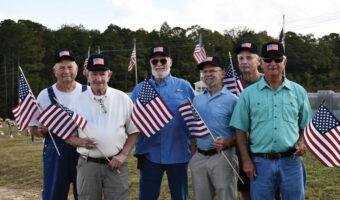
Twice a year, the Flag Crew heads out to cemeteries around the Wiregrass, planting American flags on the graves of those who served in the military.
The crew honors veterans who fought in wars and conflicts throughout the nation’s history, including the only Revolutionary War soldier believed to be buried in Houston County. In a cemetery in Black, flags are placed for 2 brothers who died in World War II — 1 killed in 1945 in a tank explosion, the other memorialized only by a marker as he was lost with the rest of the crew aboard the USS Jarvis, a Navy destroyer sunk in 1942 near Guadalcanal in the South Pacific Ocean.
“It’s the least we can do for what they did for us,” Flag Crew volunteer Philip Marsh says. “The families, those that are still living, they appreciate it. They tell us they do.”
The all-volunteer Flag Crew places flags on the graves of military service members for Memorial Day and Veterans Day each year.
The group was recently honored with a Silent Heroes of the Wiregrass award. Wiregrass Electric Cooperative and WTVY partner to recognize people who make a difference in their communities and the lives of others. Winners receive a $1,000 award.
“This effort is simple in concept but involves so much work of the volunteers honoring veterans buried throughout the Wiregrass,” WEC Vice President of Member Services and Communication Stevie Sauls says. “We’re honored to be able to support the volunteers in this way.”
Flag Crew volunteer Robert Quattlebaum says the award has already been used to buy more flags.
The effort was started by Ray Hutto, who put flags out by himself before others joined him. Hutto started with a Facebook message asking if anybody wanted a flag placed on a loved one’s grave to honor their military service. If someone wasn’t able to do it themselves, Hutto did it for them.
The effort grew as word got out. As volunteers put flags out, they often come across other graves marked with military service and add flags to those graves if they have extras. Some cemeteries even help identify veterans’ graves.
“It started out small, and it grew and grew and grew,” volunteer David McGriff says. “People would ask Robert or come up to Philip and say, ‘Would you put 1 on my granddaddy’s or my daddy’s grave or my brother’s grave’ or something like that.”
All volunteers ask for is good directions to the gravesite. And even when they’ve placed flags on graves in the past, it’s still sometimes a challenge to locate graves each year, especially in cemeteries that have been added to or where the grass is not maintained as regularly.
“It just keeps growing,” Quattlebaum says. “There’s no way, with as many cemeteries as there are, to cover them all.”