
Share

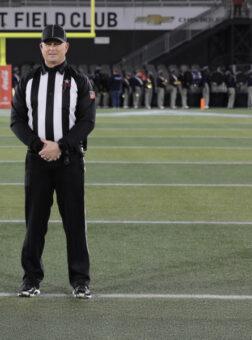 In December, Mark Olive reached a goal shared by many high school sports officials when he was chosen to officiate his first state championship football game. Olive, who works in accounting at Wiregrass Electric Cooperative, was among the officials working games during the Alabama High School Athletic Association’s Super 7 State Football Championships played over 3 days at Protective Stadium in Birmingham.
“Super 7, I guess, for a high school official, is basically their Super Bowl,” Olive says. “If you’re in this, that’s 1 of your main goals as an official in high school football.”
Olive started officiating local Little League games while also playing baseball in high school and then in college, first at Hinds Community College in Raymond, Mississippi, and later at Troy University. He officiated his first high school football game in 2019. Looking back, he wishes he had started officiating football games sooner.
“You end up being on a crew with other people, and you build a relationship with them,” Olive says. “You get to be out on the field with those high school athletes as they play the game and help them have a good atmosphere and have a fair opportunity to play a sport that they love to do.”
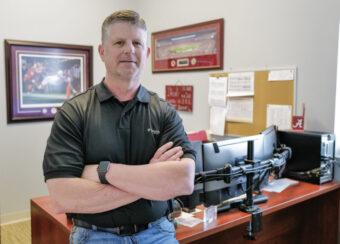
Officiating high school football requires more than just showing up on game day. Officials begin meeting weekly after July 4 to prepare for the upcoming season. During these weekly training meetings, they learn about new athletic rules and how enforcement can impact a game, Olive says.
Alabama High School Athletic Association officials have to be registered and licensed with the state association and undergo a background check. The AHSAA, the organization for sports officials, has district directors who oversee officials for different sports around the state. Those who want to become high school sports officials can submit an inquiry under the AHSAA’s website section for officials. From there, they are put in contact with the appropriate district director and attend a training meeting. Once someone becomes a high school sports official, regular state certification exams are required.
AHSAA is always looking for new officials, including former high school and college athletes who love their sport and want to remain involved, Olive says.
“There’s nothing better than having somebody who just played the game who can continue to give back to the game they love,” Olive says. “Not only do we need on-field officials, but we need clock operators.”
When the high school football season gets underway, officials meet weekly to go over the previous games and discuss upcoming contests.
“Every week we go back, and we have video that we pull for teaching moments — what we learned from those moments, what we can do to improve ourselves, what we need to look for and how we can help manage the game,” Olive says.
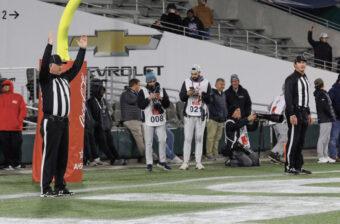
Since football games are typically played in the evening, officiating doesn’t interfere with Olive’s cooperative job. He still officiates some recreation league baseball games, but high school football is what he enjoys most. Olive says he plans to keep officiating football as long as his body agrees.
“For 2 to 2 and a half hours, there’s a lot of moving going on, versus officiating baseball,” Olive says. “There’s something always going on in a football game where every 6 seconds a new play is developing, and you’re moving.”
When they’re on the field, Olive says officials are not watching the game as a spectator would. Instead, they’re watching different zones to see what is going on all over the field.
“Most people who are watching the game, their concentration is on where the ball is,” Olive says. “As officials, we’re not watching the ball. We’re watching everything away from the ball.”
Depending on the number of officials available, there may be 5 to 7 officials on the field for a typical high school game.
“It’s better for everyone if we do have a 7-man crew; that’s just 2 more sets of eyes on the field that can see more stuff,” Olive says. “We want to make sure the game is fair, and everybody has a fair chance.”
High school sports officials, Olive says, see part of their role as helping students develop character as athletes and people. It’s fun, he says, to see young people play a game they love.
Officials try to apply rules fairly on the field and give clear explanations for the calls they make. Unfortunately, 1 side is usually going to be unhappy, he says. A great night is when nobody says anything about the officials.
“You have to make decisions really fast, and you want to make sure that it is fair and equal to both sides as much as possible,” Olive says. “We’re all human. People are going to make mistakes, players and officials. If you think you can go out there and you’re not going to make a mistake, then you’ve already made a mistake.”