
Share
As part of its mission to train compassionate doctors, Dothan’s Alabama College of Osteopathic Medicine (ACOM) is building a healthier community.
Conceived by the Houston County Healthcare Authority — a 13-member volunteer board that oversees Southeast Health, a not-for-profit regional hospital — ACOM focuses on training primary care physicians to practice in areas with limited health care options.
“Part of that is just us wanting to be good partners with community members and providing medical care in those areas of need,” says Carmen Lewis, ACOM’s vice president of institutional effectiveness.
ACOM’s coursework blends traditional medicine with lifestyle medicine and nutrition, preparing students to treat the whole person and not just symptoms.
Aaron Tillman, a 2nd-year ACOM student and physical therapist, was drawn to this holistic approach. “Our initial line of questioning is usually to the extent of ‘how is this issue affecting your life,’ and not necessarily just ‘tell me your symptoms,’” he says. “You’re able to see that you typically have a deeper relationship with your patient and you’re able to address their care with a more holistic approach.”
ACOM recently added a new community garden to its campus where students, faculty and staff plant and harvest fruits and vegetables. In addition to providing sustenance, this hands-on initiative also provides students with practical experience in preparing nutritious meals. The college’s outdoor pavilion, complete with a teaching kitchen, is used for cooking lessons to demonstrate healthy eating.
“We believe that we can impact future patients by teaching our students the importance of preparing nutritious meals, which ultimately is about disease prevention and well-being,” Lewis says.
Near the garden, a sand volleyball court and nature trails promote physical activity and wellness among students. Wellness Wednesdays, featuring morning meditations, group walks, and no meetings, contribute to the atmosphere of the campus community.
Whole-body wellness is also tied into ACOM’s educational approach. Unlike traditional medical schools, osteopathic schools like ACOM stress osteopathic manipulative treatment, or OMT, in the curriculum. The OMT lab helps students engage physically, learning to diagnose and treat certain conditions through manipulation of the body’s muscles and joints.
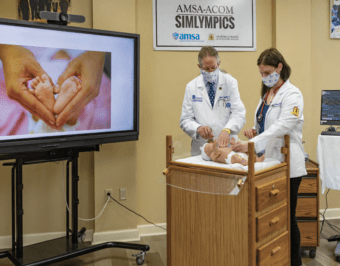
ACOM’s expanded simulation center trains students by exposing them to mock situations they’re likely to encounter as medical providers. They handle a variety of cases, from pediatric emergencies to trauma from car accidents.
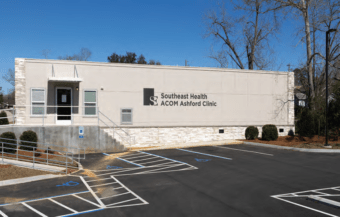
Off-campus, ACOM’s commitment to community health becomes clear in its clinical training network that requires third-year medical students to undertake a 28-day rural clinical health rotation. ACOM’s established its Ashford clinic in 2020 and the soon-to-open clinic in Taylor to provide local healthcare access for residents to receive routine or episodic care.
ACOM Dean Dr. James Jones is proud of the medical school’s comprehensive programs and robust clinical training network. ACOM currently works with 32 hospitals, spanning Alabama, Florida, Mississippi, and Georgia. All students are required to do a clinical rotation in hospice care.
“That’s not a typical standard rotation that students would participate in at a medical school, but we believe it’s important to better understand end-of-life care and really create compassionate physicians,” Lewis says.
Southeast Health CEO and ACOM President Rick Sutton stresses the importance of training and retaining skilled doctors locally and throughout Alabama. Since 2017, ACOM’s partnership with nine hospitals has led to 11 new residency programs, adding 153 slots in specialties that include psychiatry, internal medicine, and cardiology.
“We aim to create more residencies throughout the area, so when they graduate from that residency, they’re much more likely to stay in that area to practice,” Sutton says.
By increasing the number of these residency positions, ACOM ensures more graduates can complete their training locally, increasing the likelihood that they will remain in Alabama to practice.
Community service is integral to ACOM’s philosophy. With 32 student-led clubs, students are active volunteers, contributing everywhere from the neonatal care unit at Southeast Health to supporting various nonprofit organizations.
The Heart Safe initiative is a notable example of ACOM’s leadership in community health. This program trains community members in hands-on CPR and deploys AEDs, or automated external defibrillators, throughout the area. Supported by the Southeast Health Foundation, ACOM students are certified in these practices, as are members of local businesses and organizations. Dothan was recently recognized as a “Heart Safe City.”
“We have already had somebody undergoing a cardiac event that has been intervened by somebody that we trained, and an AED was deployed that we provided in this community, so it does make a difference,” Sutton says. “It saves lives.”
Sutton says plans are underway to expand the initiative to include Houston County.
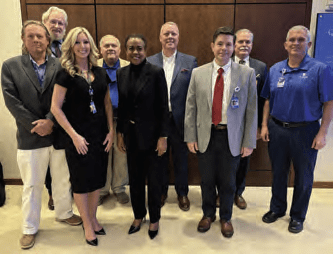
Building on this foundation of community engagement, ACOM formed a nine-member community advisory board to ensure the Wiregrass area remains closely connected to the college’s advancements. This board, which includes community leaders serving in a consultative capacity, plays a role in guiding ACOM’s initiatives. Among the board members is Brad Kimbro, Wiregrass Electric Cooperative (WEC)’s CEO, who emphasizes the regional benefits of strong healthcare.
“Our healthcare is an advantage for our Wiregrass community,” Kimbro says. “When companies consider where to establish themselves or when people consider retirement, the wonderful healthcare system we have here stands out as an economic advantage not many communities can boast.
The Willed Body Program is another unique aspect of ACOM. It allows community members to bequeath their bodies for anatomical education, providing invaluable learning opportunities. By working with real human bodies, students gain a better understanding of human anatomy through cadaver dissections than textbooks can provide.
“Understanding the weight of these patients donating their body for our education and for the betterment of our ability to care for future patients, I just think it ups the sanctity of the whole anatomical education process,” Tillman says. An annual memorial service for donors and their families is a way for students and faculty to honor their contributions. Cremated remains are returned to the family.
ACOM also uses standardized patient programs. In these, members of the community act in outpatient scenarios to help students develop their clinical skills and handle real-life medical situations with empathy and competence. Students learn to take comprehensive patient histories, perform physical exams, and develop treatment plans. They face scenarios such as managing chronic illnesses, addressing mental health issues, and dealing with acute conditions, like asthma attacks or heart failure.
As the state’s largest medical college by enrollment, ACOM’s impact continues to benefit the healthcare landscape with 77 graduates practicing in the state and 24 in the Wiregrass area. The college’s rigorous medical training and community engagement will continue to improve health outcomes in the region.