
Share

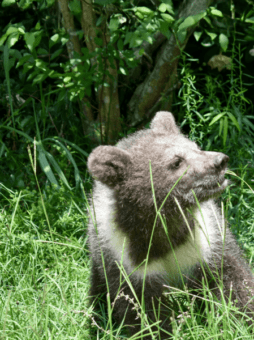
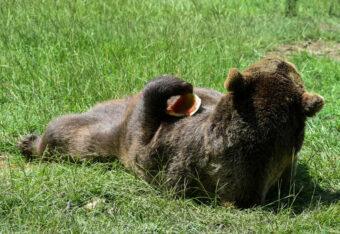
While Yogi digs into a watermelon, Tonk snoozes in the tall grass, the 27-year-old grizzly bear choosing his nap over a snack.
“He swims in the morning. From 10 to 12, he naps. Right now, it’s nap time,” Isaac Rempe says as he tries to tempt Tonk with a watermelon. “They really, really love melons, but they get so many of them, it’s just not enough of a reason for him to get up.”
17-year-old Yogi, meanwhile, not only devoured his watermelon — at 1 point balancing the rind in his large paws — but also ate Tonk’s melon.
When they’re not lounging or eating watermelon, the grizzly bears spend their days swimming in their own pond, digging up roots, and pushing down trees at Grizzly Ranch Bear Rescue in Hartford.
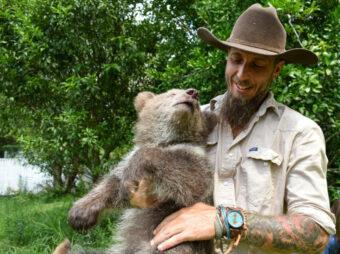
Nestled on the Choctawhatchee River, the 30-acre Grizzly Ranch opened to the public in 2024, offering tours and a unique Airbnb experience. Isaac and his wife, Angela Rempe, manage the nonprofit sanctuary and live on-site with their 2 youngest children.
Tonk and Yogi were raised from cubs to work in movies, TV, and live animal education programs. Along with the 2 grizzly bears, the Southeast Alabama rescue is home to 6 Kodiak bears, including 4-year-old siblings Charmin and Izzy.
“They were born in captivity, which means you can’t release them,” Angela says.
“They came from a facility in New Jersey.”
The siblings share an enclosure with 5-year-old Kodi, who came from a North Georgia facility that couldn’t house him. All 3 arrived at Grizzly Ranch as cubs. They vary in weight now from 275 pounds for Izzy, a female, to 300 and 450 pounds for males Kodi and Charmin, respectively. Yogi weighs in around 650 pounds, while Tonk tips the scales at 730 pounds.
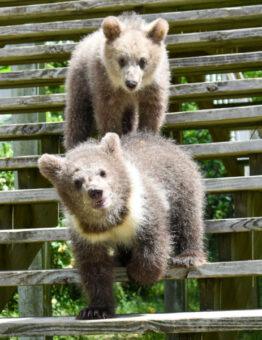
There are even younger bears at Grizzly Ranch. 3 Kodiak cubs named Betty, Bitsy and Boo are less than a year old.
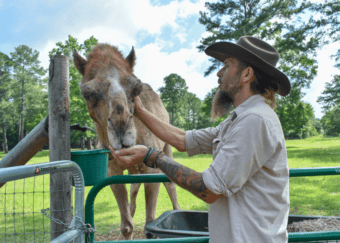
While the nonprofit’s purpose is to provide shelter for bears, Grizzly Ranch is also home to other animals, including donkeys, zebu cattle, camels, Java macaque monkeys, a mandrill, ducks, geese, chickens, goats, and turkeys.
“I started working with animals at a very, very young age,” Isaac says. “I was the kid who brought the alligator home — my mom found him in the bathtub. That was always my mission.”
Grizzly Ranch started in South Florida, founded by Isaac’s mentor, Dexter Osborn, who raised Tonk and Yogi and still works with the rescue. Isaac had a South Florida wildlife relocation business, which still supports the family, prior to taking over the rescue. Isaac’s business partner, Kevin Officer, comes from Florida to help at the sanctuary.
The Rempe family decided to leave Florida and were looking at property in Texas when they came across the site in Southeast Alabama. The property had space, ponds stocked with fish, and a home. So in 2020, the nonprofit moved to the site off County Road 41.
Licensed and inspected by the U.S. Department of Agriculture, Grizzly Ranch tours are scheduled in advance. Local schools have taken field trips to the sanctuary.
“We just started within the last year really opening up to the public,” Isaac says. “We wanted to make sure all the animals were settled in before we had groups coming out.”
8-foot-high fencing surrounds the enclosures for the 5 adult bears, with the grizzlies in 1 enclosure and the Kodiak bears in another. Shipping containers provide the bears covered shelter. Except for the primates, the other animals reside in pastures on the other side of the property.
Grizzly Ranch has actually secured old light poles from Wiregrass Electric Cooperative. Plans for the poles include using them as posts to expand the bear enclosures.
“We’re honored to support such a unique attraction and nonprofit organization,” says WEC Vice President of Member Services and Communication Stevie Sauls. “These animals deserve a home where they are well cared for and loved.”
Other than fish, the bears at Grizzly Ranch don’t eat meat on a regular basis. They get an omnivore kibble, similar to horse feed, and venison on special occasions. Breads are a huge part of their daily diet — 15 to 20 loaves each afternoon. The bears love green apples, as well as frozen grapes and blackberries, as treats.
“We wake up early, we go to bed late, and it revolves 100% around these animals,” Isaac says.
The Rempes homeschool their children, who help care for the animals, including the Kodiak cubs. The bear cubs have their own pool and frolic around the property, climbing trees and chasing the chickens and turkeys. They treat Angela as a mother figure, often making a guttural purring noise as they nuzzle up to her — a noise Isaac and Angela call a nursing giggle.
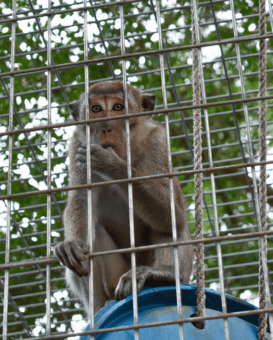
The primates at Grizzly Ranch are not currently part of the public exhibit. Rafiki, the lone mandrill — a primate known for its colorful facial markings — came to Grizzly Ranch from a private owner and is still not completely comfortable around strangers. The 2 macaques, Mac and Cheese, are kept nearby in a separate enclosure to help Rafiki socialize with other primates.
The tours and rental cabins help cover the costs of caring for the animals. While staffers work hands-on with the animals, including the bears, visitors do not. The Rempes and other caretakers spent years building trust with the animals.
The small cabins, listed on Airbnb, are decorated with a rustic wilderness aesthetic. The porches face Tonk and Yogi’s enclosure, a high fence between their pond and the cabins.
People typically find the ranch through Google reviews. Guests have stayed as long as a week in the cabins, seeing how the sanctuary operates or kayaking on the Choctawhatchee River, which is accessible from the property. Plus, they can watch 2 grizzly bears from the front porch of their cabin.
Isaac says they want guests to have a unique experience but with realistic expectations.
“The people that come out here, they come out here because they’re very passionate about what’s here,” Isaac says. “Lifelong goals and things like that are what we end up seeing more than anything.”